
Solar Panel Installation in Delhi with Government Subsidy
Rising electricity bills have made rooftop solar one of the practical options for homeowners in Delhi. A properly designed rooftop solar panel system can help a residential consumer generate electricity from sunlight, reduce dependence on grid electricity and achieve long-term savings on electricity bills.
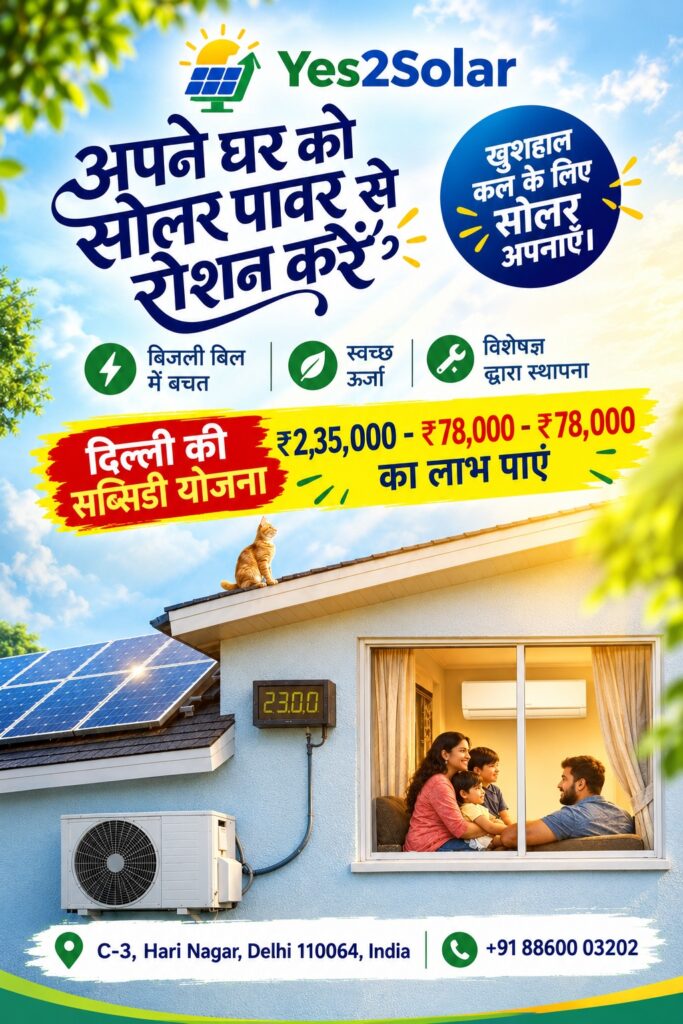
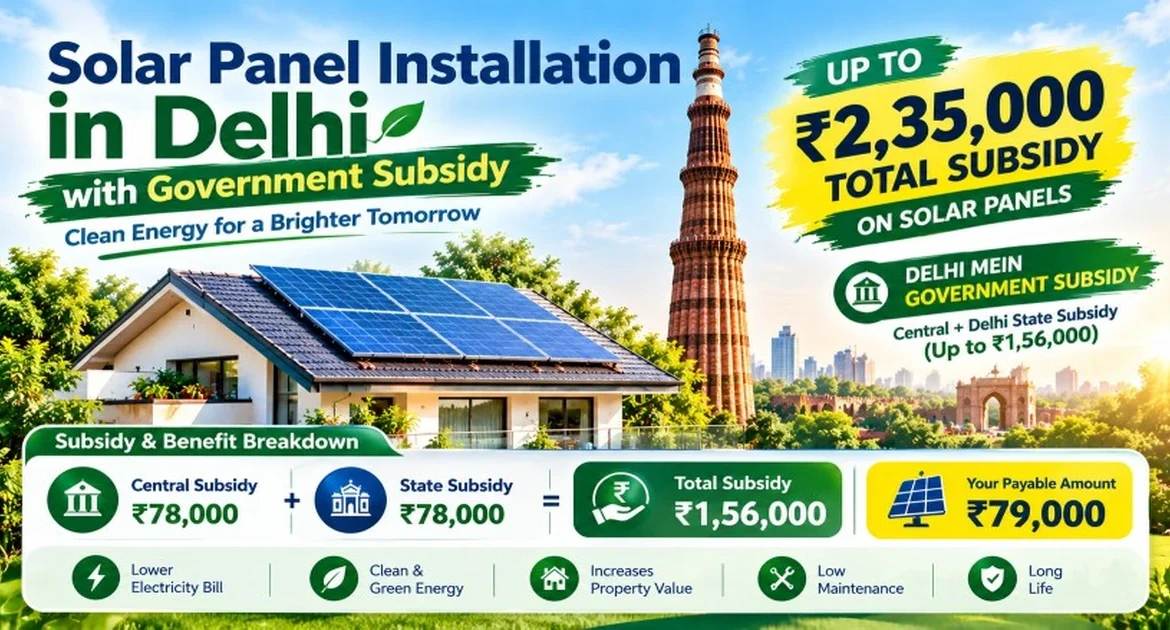
For Delhi residents, the opportunity becomes even more attractive because eligible residential consumers can benefit from Central Government subsidy under PM-Surya Ghar: Muft Bijli Yojana, along with the applicable Delhi Government state subsidy. The current Delhi Solar Portal lists Central Financial Assistance of up to ₹78,000 for eligible residential rooftop solar systems and a Delhi state capital subsidy of up to ₹78,000, subject to the applicable conditions and scheme mechanism.
⭐ Government Solar Subsidy in Delhi – Up to ₹1.56 Lakh
One of the biggest advantages of installing residential rooftop solar in Delhi is the availability of government financial support.
Under the current Central subsidy structure, eligible residential consumers can receive:
- ₹30,000 per kW for the first 2 kW
- ₹18,000 for the additional 1 kW
- Maximum Central subsidy: ₹78,000
The Delhi Solar Portal also provides for a Delhi state capital subsidy of up to ₹78,000, subject to the applicable capacity, cost and scheme conditions. Therefore, where a consumer qualifies for the maximum amounts under both components, the combined subsidy can reach up to ₹1.56 lakh. The actual subsidy available to an individual consumer depends on eligibility and the applicable rules at the time of installation.
This means a suitable rooftop solar system can significantly reduce the initial investment required from the homeowner.
Important: Government subsidy is subject to eligibility, approved procedures, installation requirements, verification and applicable scheme conditions. The final subsidy amount should be confirmed through the official Delhi Solar Portal/DISCOM process.
Why Install Rooftop Solar in Delhi?
Delhi receives substantial sunlight during the year, making rooftop solar a useful option for residential properties with suitable shadow-free roof space. A solar PV system converts sunlight into electricity that can be used by the home.
Depending on the system size, electricity consumption and generation, homeowners can reduce the amount of electricity purchased from the grid. A properly designed system can therefore provide savings over its operating life.
The Delhi Solar Portal notes that approximately 10 square metres (around 100 square feet) of roof area is required per 1 kW of solar capacity, although the actual usable area depends on roof layout, shadows, parapets, water tanks and other structures.
How Much Solar Capacity Do You Need?
The right solar system size depends mainly on your monthly electricity consumption and available roof area.
As a general reference provided by the Delhi Solar Portal:
- 0–150 units/month: approximately 1–2 kW
- 150–300 units/month: approximately 2–3 kW
- Above 300 units/month: systems above 3 kW may be suitable
A professional site assessment is recommended before selecting the final capacity. Your electricity consumption, sanctioned load, roof area, shadow conditions and DISCOM requirements should all be considered.
Solar Installation Process in Delhi
Installing a rooftop solar system involves several important steps.
1. Electricity Bill & Site Assessment
The first step is to review your electricity consumption and inspect the available rooftop space. The roof should have adequate structural suitability and sufficient shadow-free area.
2. Select an Appropriate Solar System
Based on your electricity requirement, a suitable system capacity can be recommended. The system generally includes solar panels, inverter, mounting structure, cables, protection equipment and other required balance-of-system components.
3. Government Portal Application
Eligible consumers seeking Central subsidy under PM-Surya Ghar need to follow the applicable government portal and DISCOM process. Delhi’s Solar Portal states that consumers opting for PM-Surya Ghar must select a vendor empanelled through the PM-Surya Ghar process to claim the Central subsidy.
4. Installation & Inspection
After the required approvals and installation process, the rooftop solar system is installed. The system then goes through the applicable inspection, metering and verification process.
5. Subsidy Process
Once the applicable requirements are successfully completed, the eligible subsidy is processed according to the relevant Central and Delhi Government procedures.
Benefits of Rooftop Solar Panels
Installing solar panels can provide several long-term benefits:
Lower Electricity Bills: Solar generation can reduce the amount of electricity you need to purchase from the grid.
Government Subsidy: Eligible Delhi residential consumers can benefit from Central and state financial assistance, potentially reducing the effective installation cost.
Clean Energy: Solar power is a renewable source of energy and can help reduce dependence on conventional electricity generation.
Long-Term Savings: Solar panels are designed for long-term operation, allowing homeowners to benefit from electricity generation over many years.
Better Energy Independence: Generating electricity at your own property can reduce dependence on grid electricity.
Property Value: A professionally installed renewable-energy system can be an attractive feature for a residential property.
Choose the Right Solar Installation Partner
Choosing the right solar installation company is important because the quality of the system, installation and documentation can affect the overall experience.
Before installation, homeowners should check the proposed system capacity, solar panel specifications, inverter details, mounting structure, warranty terms, installation scope, metering process and subsidy eligibility.
For consumers applying under PM-Surya Ghar, the Delhi Solar Portal specifically states that an empanelled vendor is mandatory for claiming the Central Government subsidy.
Make the Switch to Solar in Delhi
If you are planning solar panel installation in Delhi, now is a good time to understand your available options, calculate your potential subsidy and determine the appropriate system size for your home.
The Delhi Solar Portal currently shows the Delhi Solar Muft Bijli Yojana as available until 28 February 2027, subject to the scheme’s eligibility and first-come, first-served conditions.
Instead of choosing a solar system only on the basis of price, consider the complete package—system quality, installation standards, warranty, after-sales service, subsidy process and expected electricity generation.
Get Your Rooftop Solar System Installed in Delhi
Switching to rooftop solar can help you combine clean energy, lower electricity costs and available government financial assistance in one solution.
If you are a homeowner in Delhi and want to know how much solar capacity your house needs, what subsidy you may be eligible for and what your estimated installation cost will be, get a professional solar assessment before proceeding.
Go Solar. Save More. Generate Clean Energy.
Call today for a rooftop solar consultation and subsidy eligibility assessment.